- Media Center
- News
News Media Center

Quinta da Taboadella hosts technical seminar with Amine Ghanem, from Dom Pérignon
The oenologist led the meeting with Portuguese professionals, sharing his expertise on the Champagne terroir and the oenological impact of cork stoppers on the maturation of Dom Pérignon Cuvées.
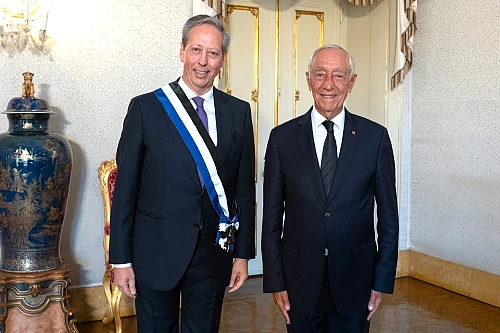
In June, Quinta da Taboadella, in Dão region, was the setting for a unique event combining French expertise, the finest Champagne wine traditions, and vibrant Portuguese winemaking. Participants learned about the tirage process and the role of cork stoppers in the second fermentation of sparkling wines. The technical seminar was led by Amine Ghanem, oenologist at Dom Pérignon. It brought together a group of Portuguese sparkling wines producers, in a meeting that also included Luísa Amorim, President and CEO of Quinta da Taboadella, and Francisco Campos, R&D manager for sparkling wines at Amorim Cork. Francisco Campos shared with the participants the findings of scientific research on the impact of tirage cork stoppers on the bottle ageing of wines.
BLIND TASTING
“Around a table, this group of wine enthusiasts shared their experiences over a cork stopper,” summarized Amine Ghanem, adding that the meeting allowed them to understand why cork stoppers are chosen: “The cork stopper acts as a link between two natural elements, the soil and the wine.” The seminar, he added, helped deepen their knowledge about these “projects of innovation, quality, and hedonism, that is, of pleasure.”
A pleasure that is expressed in the encounter between the tirage cork and the ageing wine, and in the impact that this seal has on the evolution of wine in the tirage lees.
Following an “effervescent” session in a unique setting, the day ended with a comparative sensory tasting of the exceptional Cuvée Dom Pérignon 2018, aged in cork and capsule seals. The group of oenologists recognized the superiority of Champagne aged with tirage cork stoppers over crown caps.
Luís Cabral de Almeida, oenologist at Sogrape, noted: “I was very pleased to see that a French brand such as Dom Pérignon, with a product as Portuguese as cork, managed to make such a big difference in the bottling process—in this case, of Champagne. And we all hope to use it in sparkling wine.”
Celso Pereira, from Vértice, Caves Transmontanas, praised the work carried out with Amorim Cork in terms of “learning how ageing or bottling with corks can improve quality and have repercussions on the market.”
Marta Lourenço, Murganheira’s oenologist, testified that “At first, the sparkling wine with the crown cap tirage had a slightly more aromatic nose, more romantic, so to speak. The one with the cork tirage had a nose with more intense notes, but a little more reductive. Then I left the sparkling wine in the glass and within five minutes, it was exactly the opposite: the sparkling wine with the crown cap was fairly standard; the one with the cork had a nose that kept growing, and the mouthfeel was elegant, something brilliant.”
With this event, Amorim Cork sought to share with Portuguese winemakers the state of the art of its sparkling cork stoppers, the result of long-standing scientific and oenological cooperation with its main customers.
Other News
WINE BOTTLES SEALED WITH CORK STOPPERS FREE OF MICROPLASTICS
The return of cork tirage: tradition confirmed by science
Amorim Cork and Niepoort joins forces to champion wine and cork
Helix gets a new twist

Ranked as the "Best Company for Carbon Reduction in the...